
Tree Pests and Diseases Around Derry, NH
Is emerald ash borer in Derry?
The state's forest health program wrote in its 2020 newsletter that "nearly every town in Rockingham, Hillsborough, Merrimack, Belknap, and Strafford counties is now infested" (NH Division of Forests and Lands, 2020 Forest Health newsletter, checked Nov 17, 2026). By 2022 the known infested area covered about 7,000 square miles across 194 towns, and the last stretch with no detections was the far north of Grafton and Carroll counties plus all of Coös County (NH Forest Health Highlights 2022, checked Nov 17, 2026). Aerial surveys mapped about 8,000 acres of ash mortality in 2024 and 3,267 acres of borer damage in 2025 (2024 and 2025 Highlights, checked Nov 17, 2026).
The New Hampshire Department of Agriculture, Markets and Food says "Millions of New Hampshire's landscape and forest ash trees are at risk" and asks people not to move ash logs or firewood: "Buy it where you burn it" (NH Department of Agriculture, emerald ash borer page, checked Nov 17, 2026).
What it looks like in a yard, and when treatment stops making sense
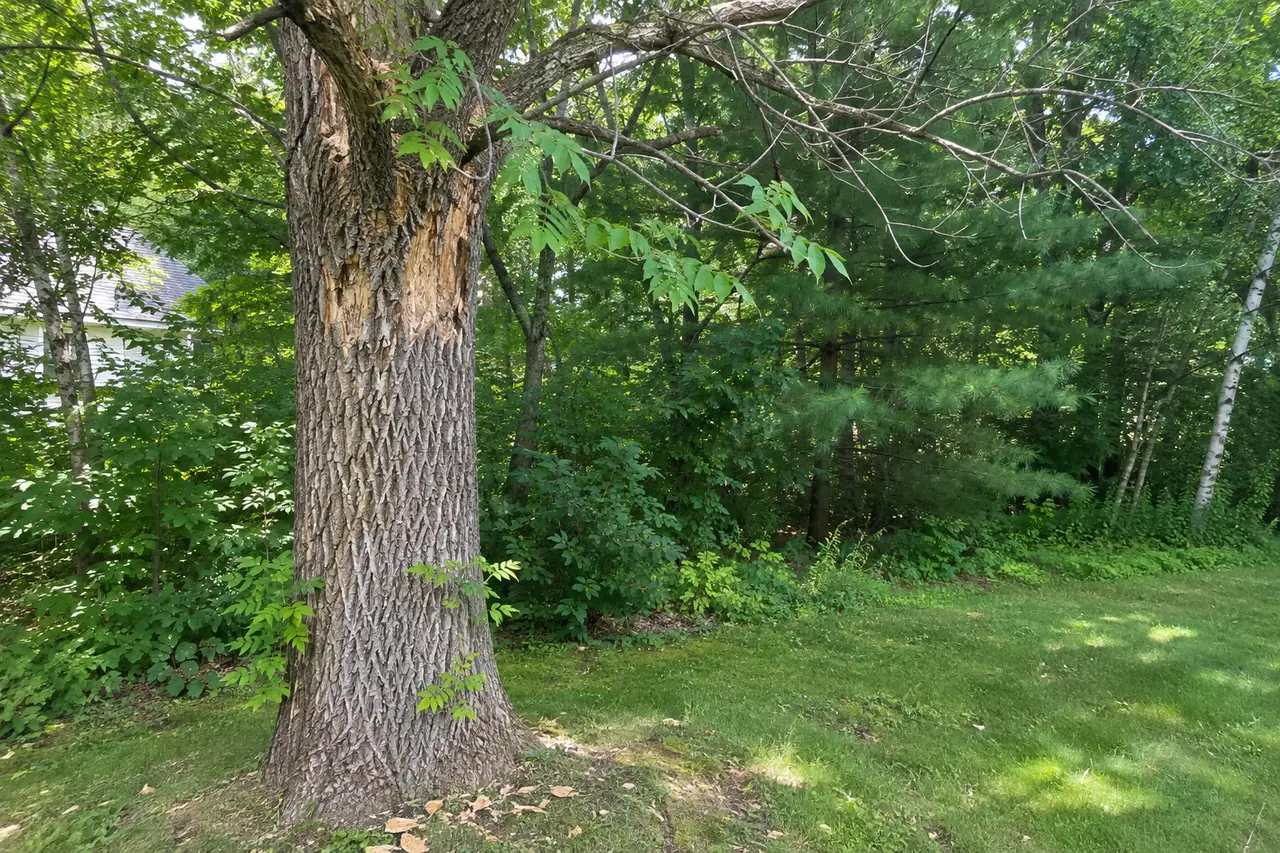
UNH Extension calls "blonding" on ash, the pale patches left where woodpeckers strip the outer bark to get at larvae, "a tell-tale sign your tree is infested." The same article says that "Most ash with more than 50% dieback should be taken down since treatment will be ineffective" (UNH Extension, July 11, 2018, checked Nov 16, 2026). With the borer reported in nearly every Rockingham County town, a healthy ash you want to keep is one to ask about treating, and an ash already more than half bare is a removal.
What is beech leaf disease, and how bad is it here?
Beech leaf disease is caused by a microscopic nematode, Litylenchus crenatae ssp. mccannii, which UNH Extension says invades beech buds in summer and fall, then feeds and overwinters inside them. UNH Extension describes "distinctive bands of darker-colored tissue between the veins of the leaves," easiest to see from underneath, along with curled, thickened leaves that drop early, and branch dieback when buds are killed (UNH Extension, July 24, 2025, checked Nov 17, 2026). The article says the disease was first found in New Hampshire in 2022 and that in southern New England, infested trees have been dying within "3-6 years."
The spread has been fast. It was confirmed in six towns in 2022, found in 89 more in 2024 for a total of 127 including nearly every town in southern New Hampshire, and in 2025 the state mapped 4,775 acres in southern New Hampshire and identified 36 more towns (Forest Health Highlights 2022, 2024 and 2025, checked Nov 17, 2026).
For woodland beech, UNH Extension says no treatment currently appears effective. For valuable landscape beech, it lists treatments that have shown promise in reducing symptoms, including potassium phosphite, a fluopyram-based foliar product and trunk injection with thiabendazole, and the state reports fungicide trials with preliminary results expected in 2026. UNH Extension asks people to report suspected beech leaf disease through NH Bugs, "especially in a town where it has not yet been detected."
Are hemlocks around Derry at risk?
Hemlock woolly adelgid, a small sap-feeding insect, was first found in New Hampshire in 1999 and is now in 120 towns and every county except Coos, according to the NH Department of Agriculture's undated page (checked Nov 16, 2026), so the count may be out of date. The department lists it as a prohibited invasive insect.
The recent news is better than for ash or beech. The 2025 Forest Health Highlights reported no new towns for the third straight year, adelgid winter survival of about 12% after a cold winter, and an introduced predator beetle, Laricobius nigrinus, established in Rockingham, Strafford and Carroll counties (NH Forest Health Highlights 2025, checked Nov 17, 2026). A hemlock with a thin, grayish crown is still worth having looked at, especially one close to a house.
Did spongy moth kill oaks around here?
The big New Hampshire outbreaks of 2021 and 2022 were centered elsewhere: about 35,000 acres around Conway and about 15,000 acres around Concord and Henniker in 2022, with smaller pockets statewide, out of 52,532 acres of defoliation mapped that year (NH Forest Health Highlights 2022, checked Nov 17, 2026). By 2024 the state counted about 13,000 acres of oak mortality from those outbreaks combined with the 2021 and 2022 droughts (2024 Highlights), and the 2025 report recorded no spongy moth activity. Oaks that were stripped twice and then went through drought are the ones that show up as dead trees a few years later.
What about yellowing white pines?
That is usually white pine needle disease, a fungal problem tied to wet springs. UNH Extension says most trees recover; see the white pines page for the details and the 2024 survey numbers.
When does a sick tree become a removal job?
A tree that is dead or mostly dead within reach of a house, a driveway, a road or a power line belongs on the list. So does one whose decline you can see getting worse each year. The tree removal page covers how that work is done around Derry, and the New Hampshire Insurance Department's guidance that a neighbor's insurer would likely pay for a fallen tree only if it was dead or weakened is a reason not to wait on a dead tree that leans toward someone else's house (NH Insurance Department, checked Nov 16, 2026).