
Tree Removal in Derry, NH
When does a tree need to come down rather than be pruned?
Pruning fixes a limb problem. Removal is the answer when the trunk, the roots or the whole crown is the problem. The usual reasons fall into a short list:
- The tree is dead or mostly dead. Ash trees are the common case. The state's forest health program wrote in 2020 that nearly every town in Rockingham County was infested with emerald ash borer (NH Division of Forests and Lands, 2020 newsletter, checked Nov 17, 2026).
- The trunk is split, hollow or leaning harder than it used to. A crack that opens and closes in the wind, fresh lifting of the soil on the side away from the lean, or mushrooms at the base all point to the trunk or roots.
- A storm has already broken it. A white pine that lost its top in ice, or an oak with a major limb torn out of the trunk, often cannot be pruned back into something sound.
- It is too close. Trees planted or left a few feet from a foundation, a septic tank or the line to the house eventually grow into a problem that no amount of trimming solves.
If you are unsure, say so when you call. The contractor looks at the tree and tells you whether pruning would do.
What does Derry ask for before a tree comes down?
For a yard tree on dry ground away from the road, nothing that we read. The Town of Derry online permits page names the permits Code Enforcement issues and does not include one for trees (checked Nov 17, 2026). The cases that do carry rules are these:
Within 50 feet of Beaver Lake, Big Island Pond or another lake over 10 acres
New Hampshire's shoreland law covers lakes and ponds "greater than 10 acres" (NHDES shoreland FAQ, checked Nov 16, 2026). In the first 50 feet, trees are scored in 25-by-50-foot grid segments, and stumps and their roots stay in the ground unless a removal is approved (RSA 483-B:9, checked Nov 16, 2026). A tree with a structural defect that poses an imminent hazard may be cut to ground level at any time without a shoreland permit, according to NHDES fact sheet SP-5. The lakefront trees page goes through it.
Inside a prime wetland buffer
Derry's zoning defines the prime wetlands buffer as the 150 feet beyond a prime wetland's edge (§ 165-77) and says forestry and tree farming there "shall first be reviewed and approved by the Conservation Commission" (§ 165-80A(2)(a)), as read in a published copy of Derry's zoning ordinance (checked Nov 17, 2026). The section does not say whether taking down one tree behind a house counts as forestry. If your back line borders a marked wetland, ask the Derry Planning Department before the work is scheduled.
On the edge of a scenic road
State law bars road repair and utility work on a designated scenic road from cutting trees that measure 15 inches or more around at 4 feet off the ground, or tearing down stone walls, without written consent from the planning board after a public hearing (RSA 231:158, checked Nov 16, 2026). Stark Road is described as a scenic road in May 2008 Derry Planning Board minutes (checked Nov 16, 2026). For a tree at the roadside on any road you suspect is scenic, a call to the Planning Department settles whether the hearing rule applies.
What happens when the tree is near the wire to the house?
The line from the pole to your house is the one most yard trees threaten. Eversource says that if you hire your own contractor, it "will temporarily remove the pole-to-house lines" so the work can go ahead safely (Eversource NH tree trimming FAQs, checked Nov 16, 2026). Liberty Utilities, which serves part of Derry, says major work such as removing a tree "must be performed by you or your contractor" and requires disconnecting service (Liberty vegetation maintenance page, checked Nov 16, 2026). Disconnects take scheduling, so mention the wire when you first call.
The New Hampshire Department of Energy, Eversource and Unitil told homeowners and private tree crews in 2023 to stay at least 10 feet from power lines and to plan where every piece will fall (NH Department of Energy, checked Nov 17, 2026). That warning followed accidents in which, NHPR reported, five tree trimmers were shocked or contacted lines and one died at a Nashua home.
How does a removal usually go on a Derry lot?
Every crew has its own routine, but the job almost always follows the same order:
- The site visit. The contractor looks at the tree, the drop zone, the access for a truck and chipper, the wires, and anything under the canopy such as a septic leach field, a deck or a garden.
- The plan for getting it down. A tree with open ground on one side may be felled in one piece. A pine leaning over the house is usually climbed or reached with a bucket or crane and taken down in sections, with heavy pieces lowered on ropes.
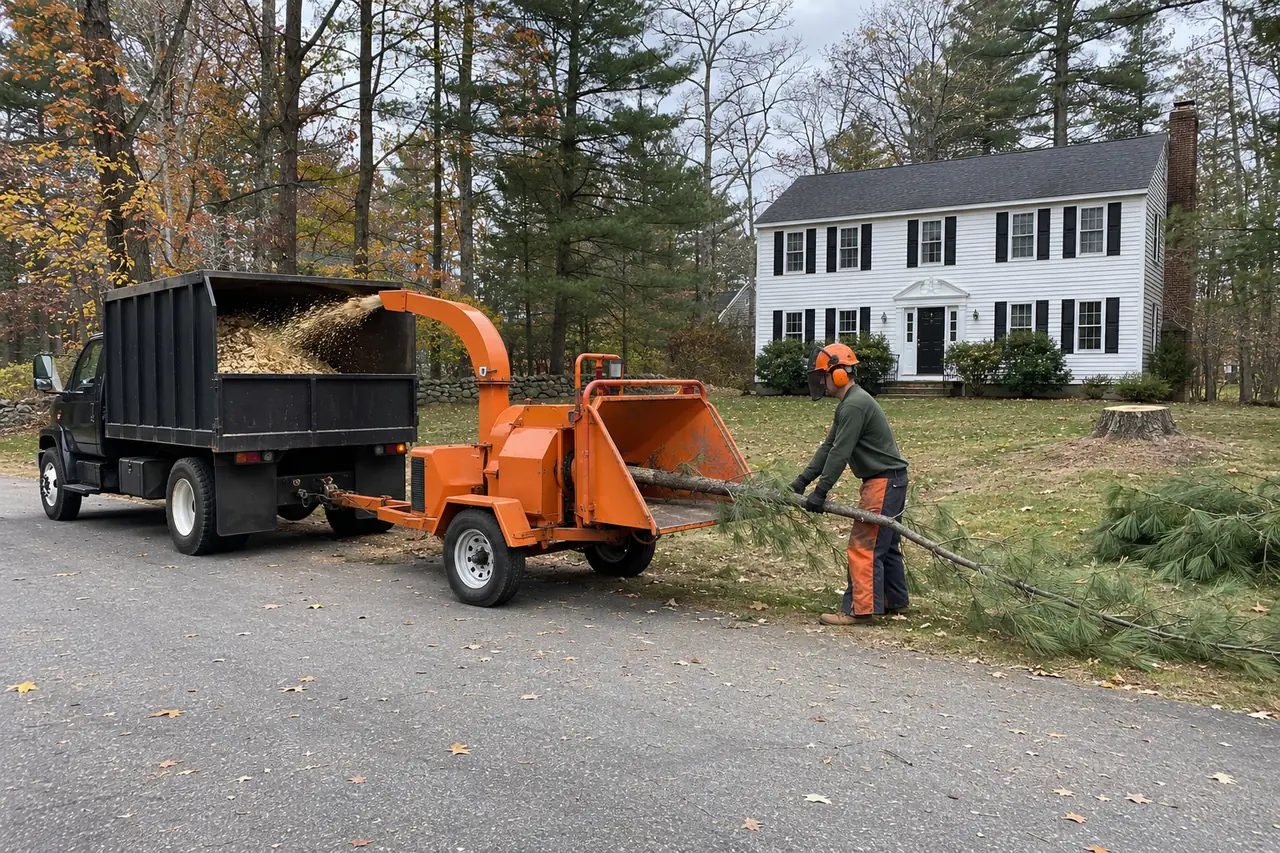
- Brush. Limbs go through a chipper parked at the street, and the chips blow straight into the truck.
- Wood. The trunk is cut into rounds. Many homeowners keep them for firewood; otherwise the contractor hauls them.
- The stump. It is cut low. Grinding it out is a separate step; see the stump grinding page.
Where does the wood go?
This matters in Derry. The Derry Transfer Station takes brush only if it comes from a resident's own Derry property, a brush policy the town has had since 2015 (checked Nov 17, 2026). On the town's fee schedule, logs over 5 inches in diameter count as construction and demolition debris and cost $0.11 a pound for residents and $0.13 a pound for non-residents and contractors (effective Sept. 15, 2023; checked Nov 17, 2026). At those rates a load of oak rounds adds up fast, so it is worth asking whether hauling is in the price.
If you plan to burn the brush yourself, New Hampshire requires a written fire permit for outdoor burning unless snow covers the ground around the fire (RSA 227-L:17, checked Nov 16, 2026); towns can set their own rules, so ask the Derry Fire Department. And the state allows burning of brush and untreated wood no more than 5 inches in diameter (NH Division of Forests and Lands, checked Nov 17, 2026).
Does cutting trees trigger New Hampshire's timber tax?
Not for shade and ornamental trees. UNH Extension's overview of the timber yield tax lists shade and ornamental trees, fruit trees and a few other categories as exceptions, plus 20 cords of firewood for domestic heating and 10,000 board feet of sawlogs for personal use (UNH Extension, RSA 79 overview, checked Nov 16, 2026). Selling logs, or cutting more than those personal-use amounts, is a different matter, and the town's assessing office handles the intent-to-cut form.
What does tree removal cost near Derry?
HomeGuide puts tree removal in Boston at $400 to $2,700 per tree, and nationally at $300 to $1,000 for a tree 30 to 60 feet tall and $650 to $2,000 for one 60 to 80 feet tall (HomeGuide, checked Nov 17, 2026). Crane help runs $500 to $2,500 a day extra in the same guide. The prices page has the full table and the Derry-specific things that move a price.